Psychedelics temporarily open a state of heightened neuroplasticity — your brain becomes more flexible, more connected, and able to see old patterns with entirely new eyes. What you've known intellectually for years can suddenly become understood in a new way - felt, understood, known in the body - and thus integrated in a way that creates real behavior change.
But the medicine is not the magic. Psychedelics amplify whatever environment they're in — mindset, emotional state, physical space, and intention determine 95% of the outcome. They're not a cure on their own; they are a catalytic tool that works in partnership with preparation, integration, and skilled support.
Clinical research now shows remarkable results across anxiety, depression, PTSD, addiction, eating disorders, end-of-life distress, chronic pain, and more — not because these are separate issues, but because they all stem from disconnection. Psychedelics help restore connection: to self, to others, and to the world.
In short: psychedelics expand perception, reopen the brain's capacity to change, and—when held in the right container—create the conditions for healing that can be profound, lasting, and life-defining.
Psychedelics induce neuroplasticity and may produce neurogenesis — in a way, returning you to a childlike brain. A brain that is creating new neural connections. A brain where areas that have been walled off or repressed come back online and communicate with one another.
The world outside you is the same, but you're able to see it with entirely new eyes. This is not merely a cognitive or visual experience. Psychedelics open a window to all of your senses.
Very often, someone who has known something intellectually for years — or even decades — suddenly has an embodied, emotional knowing of it. In that transition, they move from self-criticism (“I know this, so why can't I do it?”) to dependable action (“I understand this, so now I must do it.”)
Think about looking up at the sky with your eyeballs: you can see only the visual spectrum, a narrow band of light. But when we point Hubble or the James Webb Space Telescope at the same sky, we suddenly see thousands of times more information. The information was always there — the device we were using simply had a narrower wavelength of sensitivity.
Psychedelics work the same way. You are looking at the same world, but your ability to see, feel, understand, and metabolize what was already there — internally and externally — becomes vastly expanded.
Because of this amplification, the environment and context in which psychedelics are used is everything — truly 95% of the battle.
That's why we have studied thousands of years of human history and the most current science to pull out the best, most evidence-based practices — from ancient ritual to clinical labs at Johns Hopkins — to create the conditions best suited for healing, growth, and collective transformation.
This is not the end. We are learning every day. You are part of that learning and part of that experience.
Psilocybin is the most well-known active compound in Psilocybe cubensis, the strain of “magic mushrooms” we use at SANCTUM. Less commonly known is that psilocybin converts into psilocin, which interacts with your subjective perception and consciousness.
In the brain, these compounds bind to the 5-HT2A receptor in your serotonergic system.
This induces a state of neuroplasticity — a “critical window” where you can see things differently, and allow your mind to change, heal, and grow.
At a cellular level, the brain is repairing and creating new connections.
Subjectively, you may experience:
Many mental health conditions — though experienced as depression, anxiety, PTSD, etc. — may actually be rooted in stories your brain created to keep you safe in the past, but that now cause suffering in the present.
By re-experiencing and re-understanding these stories, you may relieve not just symptoms (as with traditional pharmacology), but the basis for those symptoms.
We are beginning, for the first time, to speak in the language of “cure.”
Though fewer in number, early clinical studies and countless anecdotal reports show significant improvements even in those with “healthy normal” brains.
Psychedelic experiences frequently elicit “mystical,” “unity,” “noetic,” and “ineffable” qualities — a transcendent sense of connection to all things.
Participants in clinical trials often rate their experience among the most meaningful of their lives, comparable to the birth of a child.
Psychedelics are among the most incredible and miraculous things in the universe — and they are not always what they seem.
Psychedelics are not the answer by themselves. They are not a silver bullet. They are not magic.
Psychedelics are system thinkers. They are symbiotic.
Think about salt:
You've probably never eaten a dinner made solely of salt. But you've also probably never eaten a dinner without salt.
Salt is not the meal — but it makes everything more itself. It is a flavor enhancer.
Similarly, psychedelics are a nonspecific amplifier.
They pick up on and work with everything in their environment, accelerating and amplifying it in ways nothing else can.
This includes your own brain.
Taking a psychedelic at a concert is not the same as taking one in a therapeutic setting.
Taking a psychedelic in one therapeutic setting is not the same as another therapeutic setting.
This is true even when controlling for dose, the person, and the medicine.
Context is everything.
Set (mindset) and setting (physical, auditory, social environment) drive 95% of long-term efficacy and behavior change.
From the moment you decide to take a psychedelic — even months before — every action or inaction shapes how you will interact with your experience and what results you will get
Psychedelics are demonstrating — in clinically controlled laboratory environments — results that are an order of magnitude more effective than any other known treatment for a wide variety of conditions, including:
At first glance, this makes no sense. How could one class of compound treat so many different conditions?
Because we've been looking at it all wrong.
These aren't separate conditions. They are different presentations of the same core condition: disconnection, misalignment, and unsafety — within ourselves, our communities, our society, and our environment.
Psychedelics help us reorient and reorganize this core condition. This is why, for the first time, people have begun whispering the word “cure.”
The medicine is so powerful it can also be aimed at human optimization. Early findings show brains that appear one to three years younger after a single treatment. These results are early, but incredibly promising.
Your safety is the foundation. A felt sense of safety is a prerequisite to all healing and inner work. We cultivate this at every level and step of your journey – from a personalized medical and safety screening, preparation, ceremony, and integration supported by licensed professionals inside a highly structured environment designed to reduce risk and maximize benefit.
Below, you will find some of the most interesting studies, documentaries, and podcasts on psychedelic medicine to understand the current state of the field.
Podcast
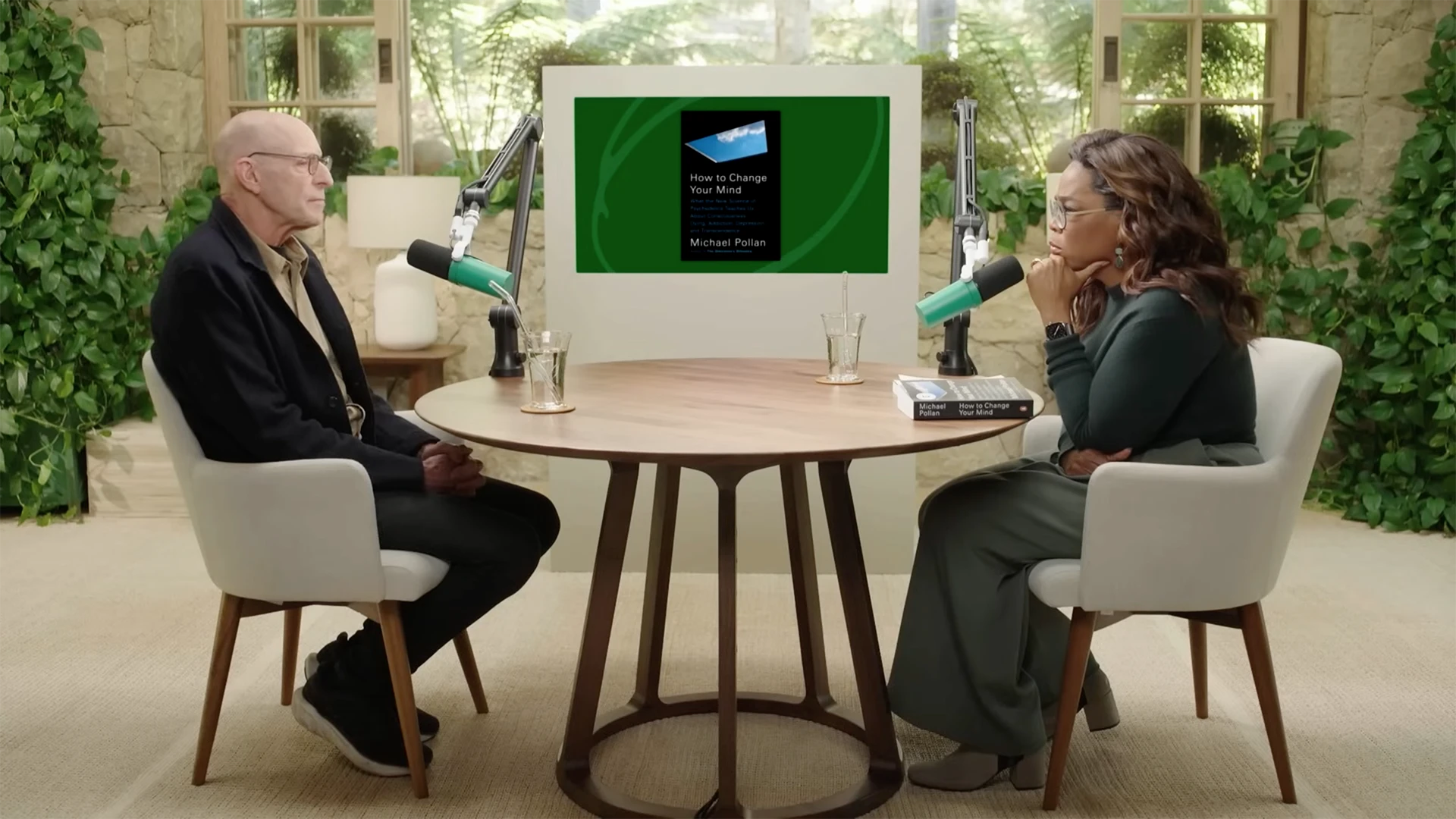
Oprah and Harvard Professor Share How Psychedelics Are Actually Healing
Listen to the Podcast
Book
What the New Science of Psychedelics Teaches Us About Consciousness, Dying, Addiction, Depression, and Transcendence
Get the book
Podcast
How Psilocybin Can Rewire Our Brain, Its Therapeutic Benefits & Its Risks
Listen to the Podcast
Book
The Search for the Original Tree of Knowledge — A Radical History of Plants, Drugs, and Human Evolution
Get the book
Article
A History of Psychedelics as Medicine — Altering Perceptions on Psychedelic Therapy
Read the Article Clinical Trials & Studies